I’m terrified of exposing myself. The idea of being seen gives me chills, and I’ve spent perhaps my whole life hiding. Until one day, alone at home, a sudden urge was born to spin wildly with my arms wide open to the sound of King Crimson, and what happened next made me question, well, basically everything.

I spun and spun like a madman, something I probably hadn’t done since I was a kid. In fact, the first time in ages I’d done anything other than a task with a deadline to meet, with a crystal-clear purpose broken down into several stages carefully designed for the project’s success and a team’s synergy. Phew. No. This time I just wanted to spin. Spin for the sake of spinning. An exuberant uselessness and, therefore, freedom. Free of any external purpose beyond spinning for spinning’s sake. Because I felt like it, because, well, just because.
With my arms loose in the wind, blurred vision, and dizziness setting in, there also comes the attempt to forget that, pushing thirty, if I fall and break my hip I’ll have to spend about three months hospitalized waiting for surgery through the public health system.
But I didn’t need the public health system, because it was only some five seconds of spinning before an extreme, paralyzing shame took hold of me. That made me furious. Shame, seriously? Of what? And far more importantly, of WHOM????????? I felt outraged by it and spent the next few hours having a heated argument with myself trying to understand. It got ugly: me and I nearly came to blows.
This constant feeling of shame has followed me for so long that, no matter how hard I tried, I couldn’t remember when it started. It’s as if it had always been this way.
So I set off on a journey to try to understand. I went to my parents’ house to dig through old photos in search of something and, talking with my mother, I stumbled onto some interesting clues and paradoxes.
As a child, she said, I would do anything to get attention, but everyone was forbidden to give it. I’d dance and sing in my corner, and if I suspected someone was watching, I’d burst into tears.
Like the song Achilles Come Down - Gang of Youths: “You crave the applause yet hate the attention”
But no, it wasn’t always like this.
Let me talk!
The year was 2005, I was in my first decade of life, and I carried an enormous urge to shout “let me talk!” every time I saw a group of adults having a conversation. I demanded the attention you’d give to a Martin Luther King, and what did I have to say? I have no idea, but I’m almost certain it had nothing to do with their subject. I think I just wanted to take advantage of the audience already gathered.
I also loved grabbing my grandfather’s old camera and recording, with my brother, “It’s So Funny I Forgot to Laugh.” We’d present it at night on the living room TV with no fear of tomorrow. When there was no camera, we’d improvise plays and ridiculous dances, and it was great to see people rolling with laughter.
I considered myself an inventor. I’d make stuff, take it to school, and show it to friends and teachers. I remember they liked it. I loved seeing their incredulous eyes facing a cardboard box walking on its own, or how glued they got to racing games made of a plastic bottle and a recycled motor. I also always played the zither at the school talent shows.
Making things and showing them to people: that made me wake up naturally before 6 a.m., electrified to enjoy every second of the day and create whatever popped into my head. That was the meaning of my existence.
But something happened. That child vanished, and no one ever saw him again, to this day.
Some twenty years went by and I still feel that, in a way, that inventor, scientist, and artist exists in here, somewhere, very well hidden, with an enormous desire to come out and create again. But the days pass, one after another, and fear comes out victorious. Until I decided to spin like an idiot.
Who is THE idiot?
Think with me: being absolutely alone at home, whose gaze and judgment would bring me shame? It was frightening for me to realize there is an inner gaze judging us all the time. But how is that possible?
Being ashamed of acting like an idiot in public makes a little sense. We pilot a biomechanical suit terrifyingly efficient at learning and adapting in order to survive. In an era when being accepted by the tribe meant survival and the chance to reproduce, doing something strange, something that frightened your own pack, could mean being cast out and having fewer chances of surviving. To protect ourselves from that, we developed the power to feel a terrible discomfort at doing anything that might be even slightly strange in our culture. That lesson is written into our DNA.
But what about when we’re alone? Far from anyone’s gaze?
In trying to better understand what’s going on here, I ended up tripping over some very interesting perspectives from existentialist philosophy.
Sartre and why hell is other people
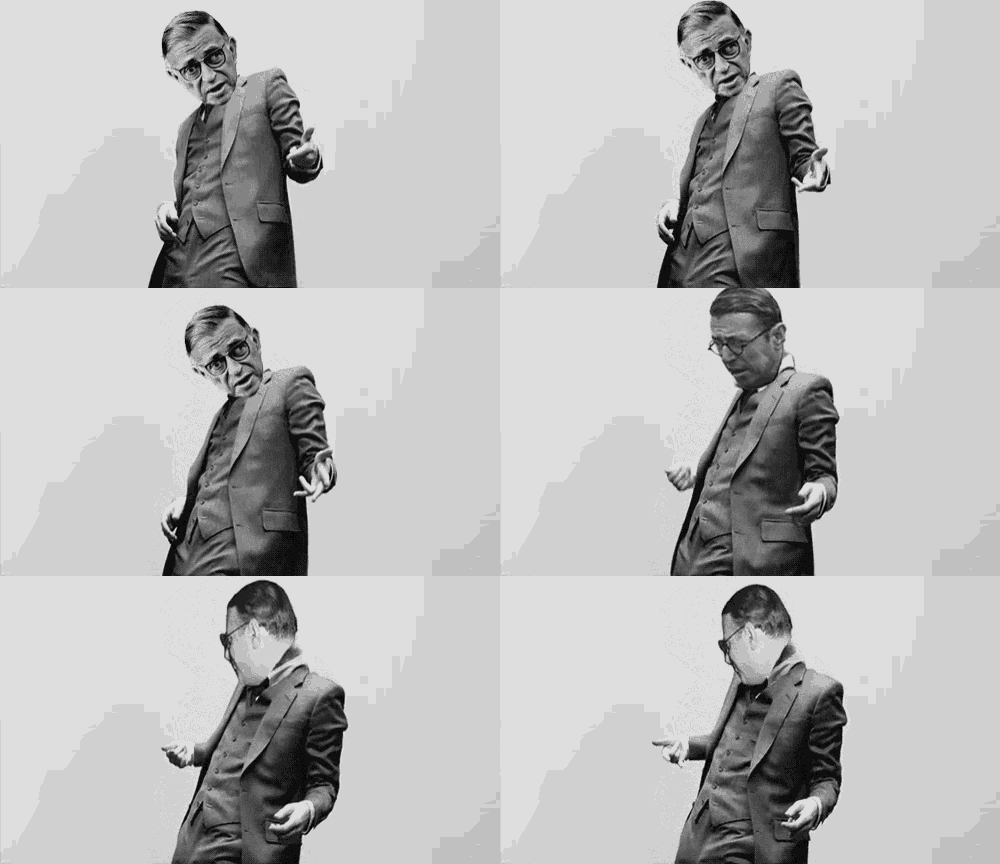
Jean-Paul Sartre, one of the greatest figures of twentieth-century existentialism, wrote in “Being and Nothingness,” his most iconic work:
“If there is an Other, whoever he may be, wherever he may be, whatever his relations with me… I have an outside, I have a nature; my original fall is the existence of the Other.” (Being and Nothingness).
Imagine you’re walking down a hallway, you hear strange noises coming from a door, and you decide to look through the keyhole. The scene you witness completely hijacks your attention. For a second you even forget your own existence, until you become aware not only of your existence but also of the possibility of another existence catching you in your snooping. You jump back in shame, whether or not you were caught, because the mere possibility of being caught is already enough.
It’s as if, even alone, the idea of an ‘other’ were already there. Always there. Invisible, but present, watching you, ready to unleash all the shame at the slightest sign of ‘inappropriate conduct.’ It’s a mental copy of an object that represents “the other,” and which, even being a mental representation, keeps playing the very same role in the “real” world, in the sense of being outside the imaginary.
Sartre sees the world as a collection of objects that can be classified into Being-in-itself (Être-en-soi) and Being-for-itself (Être-pour-soi).
Being-in-itself is closed. These are materials with no awareness of themselves. Sartre says they are “opaque” and “complete,” because they simply are what they are, with no capacity to change internally through their own will and thought, and therefore have no freedom. They are passive to the existence imposed on them, with no possibility of change by free and spontaneous will. It’s the chair, the stone, that unemployed uncle of yours on the couch, and so on.
Being-for-itself, on the other hand, is open. It isn’t limited by an imposed existence; instead, it stands constantly before a choice. At each step, 360 possibilities that a stone, or even a bird, would never be capable of, even though the bird is alive (a whole other can of worms for another time).
At the same time, this almost infinite freedom comes at a price: it’s mandatory. We are as condemned to be free as the rest of the objects are obligated not to be.
We are pure possibility and transcendence, because we are constantly pushing our being toward a becoming, a future possibility that doesn’t exist yet but could, driven by our choices. We are pure emptiness, we are transcendent and anguished. We are anguished precisely because we are born without an instruction manual telling us either why or how we live.
As professor Clóvis de Barros Filho puts it:
The wind winds, the tide tides, the toad toads, and a stick up your a#.
To understand shame, you have to understand what happens when the being-for-itself meets another being-for-itself.
Consciousness cannot encompass the whole infinity of a transcendent being. So what we do all the time is simplify objects to make them fit our limited mind. Then what happens when one transcendent being is seen by another is a reduction to a supposed being-in-itself. We are simplified and objectified. This crushing simplification breaks all the transcendence of the ego, making us shrink to a being-in-itself, limited and cut off from our true nature, which is to be free and transcendental. This happens when we are the focus of someone’s consciousness, whether another’s or our own.
That’s why doing something shameful can mean being reduced to a being-in-itself, something the psyche will always flee from, since its true nature is to be transcendent.
In the psychoanalysis of Jacques Lacan, the so-called Big Other is the symbolic instance that represents language, rules, norms, and social expectations. It’s like an invisible “field” that organizes how we relate to the world and to other people.
When you do something, even alone, the Big Other works like an internal judge evaluating your actions. This happens because, over the course of your life, you internalized those social norms. It’s as if a part of you were always thinking: “What would they think of this?”
Anyway, thinking about this made me realize that it isn’t really the spinning I’m ashamed of. It’s expressing myself, even alone. Which is absurd. The result: I feel like I have no idea who I am. “Knowing yourself” is literally impossible for someone incapable of expressing themselves freely, and I can’t allow myself even one more day like this.
Which brings me to the great paradox that haunts me:
Why publish this or that?
I’ve been caught in the crossfire between two impulses: an immense desire to create and a resistance just as immense.
What for? For whom? It’s useless. Nobody needs this. What are you after, whose attention are you trying to grab? What are you going to do with this? Pathetic! - Elton’s Mind.
The fact is, I’ve been trying to create things just for myself for a while now and I’ve failed miserably. But the mere fact of writing these lines thinking that they could potentially be read by another person makes everything automatically different. My thoughts organize themselves, I can see a line of reasoning forming with intention and far more clarity, fortunately or unfortunately, in a way, it turns out better.
The fact is that, even though I still hate “being seen” today, some evidence suggests that, even unconsciously, the child still exists and longs for the stage. Like playing the violin, for example. Why would an almost-recluse choose the highest, loudest instrument possible? On top of the demand for perfect notes. A single slip and you can ruin the whole piece all by yourself.
Another thing is that, for some reason, I feel very comfortable speaking in public. College seminars were my favorite moments; I felt really good, especially during the preparation part. I like the way I manage to articulate ideas when I know I’ll have to present them.
I don’t think it’s pure ego, but maybe an attraction to that almost-magical effect that exists in doing anything another person might see.
I like the way ideas organize themselves when they know they’ll be put on display.
Has it ever happened that you go weeks without having anyone over, and your body shows not a single sign of energy to tidy anything up? You even try, but it’s as if the energy simply doesn’t exist. You don’t even know where to start and everything tangles up in your head, every movement feels exhausting and almost always ends in giving up after, with great effort, having pulled off the feat of putting two or three objects in their place. And the very moment you find out you’ll be having a visitor, you turn into a Super Saiyan and everything makes sense. You look at the mess and now your last name is efficiency.
Producing things for myself is like cleaning the house without knowing where to start. An exhausting, confusing process that almost always ends in giving up. But the moment I imagine that another person might see it, the ideas fall into line. It’s as if the possibility of an external gaze awakened an energy that, alone, I can’t access.
The times I’ve tried to write these lines are countless. And this is the first time the words make at least a little sense, only because I’m writing them with the knowledge that this will be published and, therefore, has the potential to be seen by another person.
Why are we so insensitive toward ourselves? Why does our own gaze matter so much less than the other’s gaze? It’s bizarre that even the supposed “gaze of the other” that lives inside us seems to hold far more power than our own.
I don’t want anyone’s attention. I just really need to create again. I suspect something extremely valuable might emerge from this and, in truth, I’m publishing while rooting for no one to see it. But publishing was the only way I managed to convince my primitive brain to cooperate, at least a little.
This blog is, for me, an act of revolt against the Big Other. With every line written, every project finished, every encounter with the world, I feel a little closer to myself. Life is a single breath, and I refuse to pass through it without having managed to express everything I can in every way possible, whether about philosophy, technology, art, literature, or whatever else pops into my head.
I think it’s unlikely that anything I say or do here will be of any use to anyone, but that’s the point: it doesn’t have to be. It’s no longer about being useful. It’s now about taking back the reins, getting ever closer to Being, and if it’s going to be useless, let it be useless, free, and transcendent.
PS: If you read this far, thank you so much and a very warm welcome to the head of an obsessive neurotic who is, every now and then, highly functional.