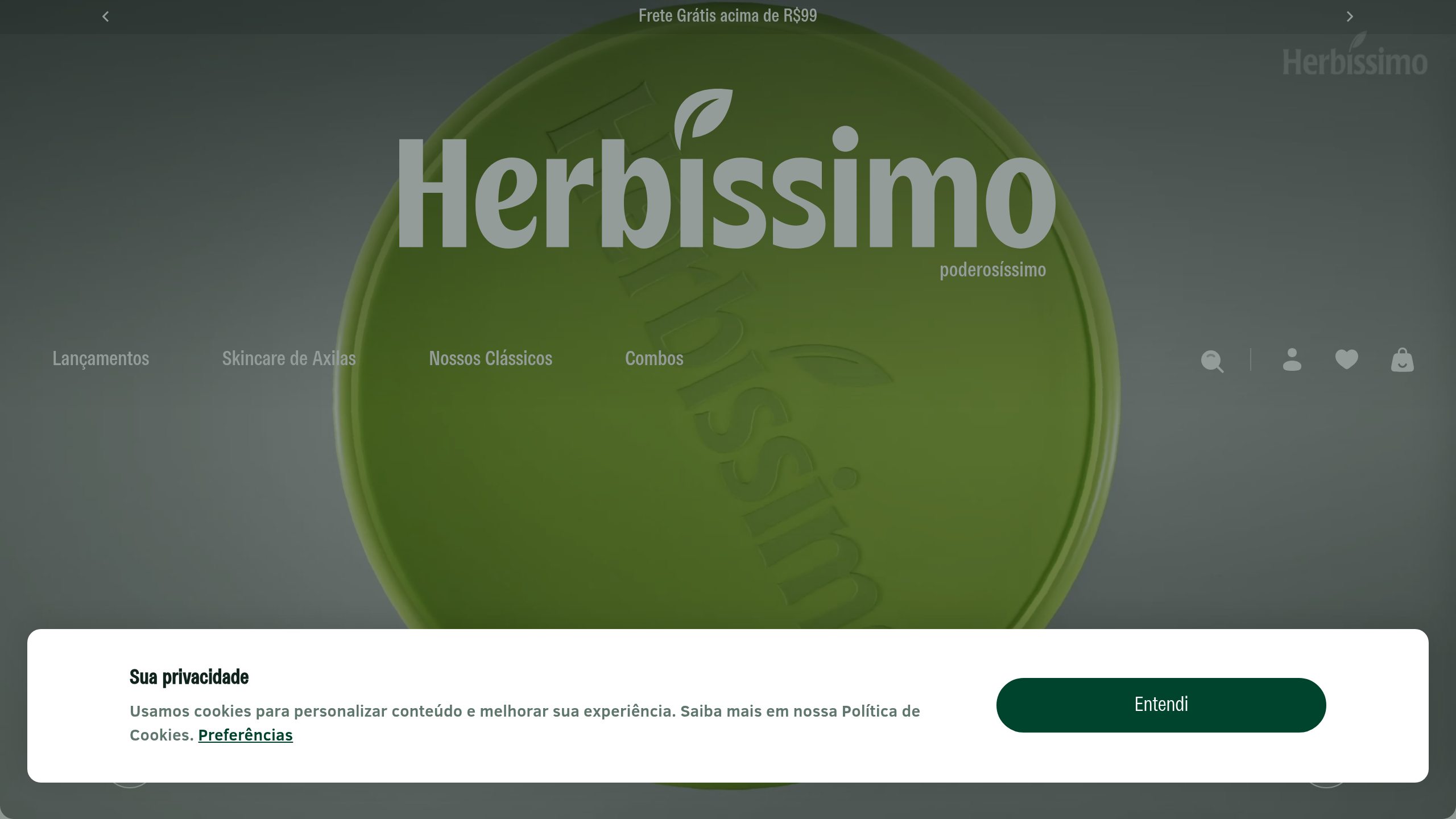
The project
Herbíssimo is a brand by Dana Cosméticos, a pioneer of the underarm skincare concept in Brazil. The challenge was to build the e-commerce from scratch on FastStore 3.x - and at the same time use this project as a pilot for the AIvengers Initiative, an internal AI-assisted development experiment I was designing in parallel.
I’m the Tech Lead. I had to deliver a real e-commerce site for a real client, within budget, and run a scientific experiment at the same time. If the AI got in the way more than it helped, the project would pay the price - not a dashboard.
The scope cut
The original scope had seven feature packages. They didn’t all fit the budget. I had to kill two: the personalization Quiz and the subscription Modal.
Each cut hurt. The Quiz was the feature marketing wanted most. Regionalization made business sense. But the real choice wasn’t “deliver everything or nothing” - it was “deliver five things well or seven half-baked.” I chose a solid go-live.
That’s part of the Tech Lead job too: knowing what not to deliver.
The squad
The project involved two developers, a UX designer, internal QA from Cadastra, QA on the client side, an architecture specialist, and a PO. My direct responsibility was over the developers and the technical decisions - FastStore 3.x architecture, design system, integrations, and everything that had to be solved in the code.
I did the technical kickstart of the project and was responsible for the go-live. I wrote more than ten technical documents in cadastra-docs, Cadastra’s internal technical knowledge base.
How the project evolved
What starts as an implementation rarely ends the same way. After the layout approval, extra features came up that weren’t in the original scope - all absorbed by the budget thanks to the time saved with AI.
The QA process ran in two stages: internal and with the client. The cycles were fast. Training the client’s team on the Headless CMS happened before the go-live.
The experiment inside the project
During the 15 business days of development, the two devs worked with Claude Code Max 5x + Figma MCP. I tracked hours, tasks, and token consumption daily - but that was the measurement layer, not the work itself.
The work itself was Tech Lead work: code review of everything that shipped, architectural decisions whenever a fork appeared, resolving technical blockers, calibrating the context engineering whenever the AI started getting some type of component wrong. When a dev got stuck on a proprietary FastStore integration problem, it was my job to step in, understand what was going on, and define the path. When the AI generated code that passed visually but had a structural problem, it was the code review that caught it - not the dev alone.
Running the experiment and delivering the project weren’t separate tasks. They were the same thing at the same time.
The hypothesis was that AI would cut time by at least 30%. I hit 57% vs Cadastra’s historical FastStore B2C median (141h actual vs 328h baseline), or 43% vs the project’s opening estimate. Both devs with indexes consistent with each other.
What wasn’t in the hypothesis: with more time to spare, quality went up too. Fewer hacks, more care, the project’s QA rate dropped from ~11% (FastStore B2C baseline) to 2%. The AI didn’t replace anyone - it created space for people to do better at what they already knew how to do.
What I learned
Scope is a technical decision, not just a business one. A scientific experiment and a real delivery aren’t incompatible if you plan it right. And AI in development works - but it works much better when the context is well built. Without cadastra-docs as infrastructure, the results would have been different.
Go-live: 03/25/2026 - within budget, with margin.
Link: herbissimo.com.br
Technologies
- FastStore 3.x - VTEX headless framework
- Next.js 13+ / React 18 - SSR/SSG
- TypeScript
- SCSS Modules - design system
- VTEX Headless CMS - content management
- Claude Code Max 5x + Figma MCP - AI-assisted development